Scalability
TL;DR
MENoBiS is designed to keep public workflows sparse or O(N) in memory. Large N is possible when you can afford the all-pairs time required by some constraints.
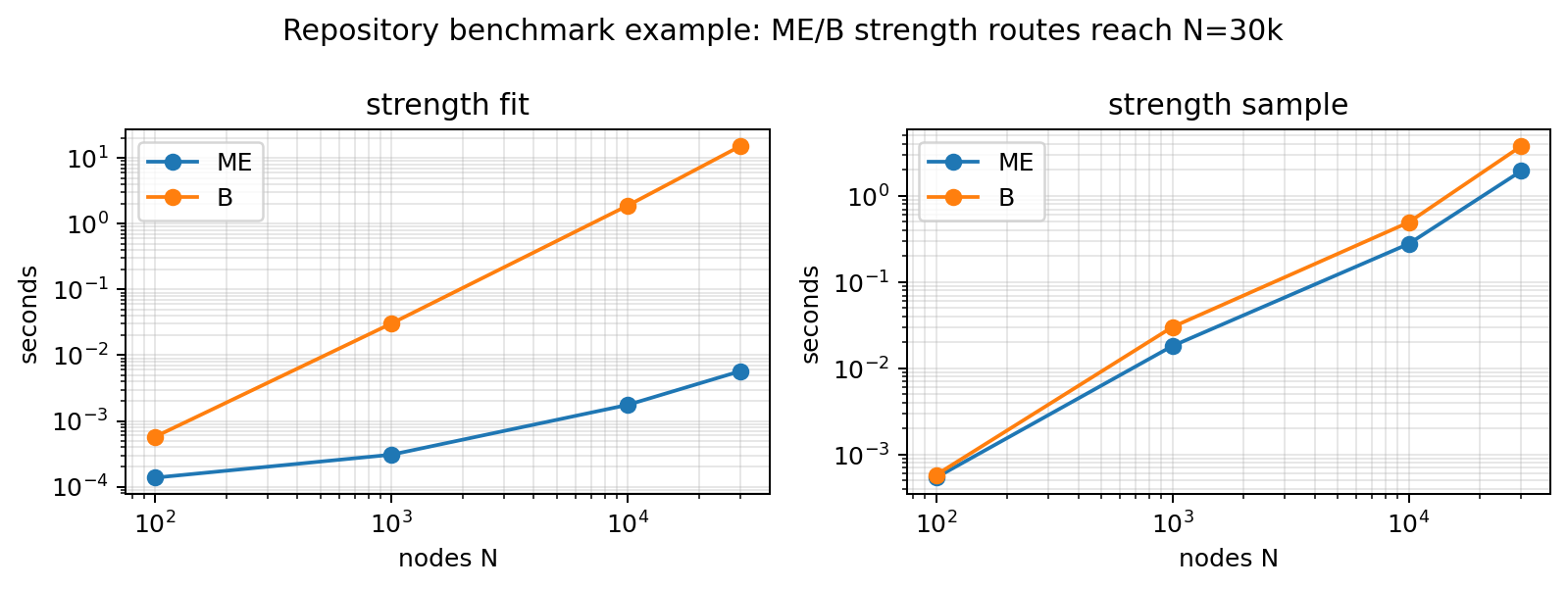
Benchmark context
The plot uses stored repository benchmark results for ME/B strength routes. Re-run the benchmark CLI on your machine for local wall-clock numbers.
Operation costs
| Operation | Typical complexity | Notes |
|---|---|---|
| edge-list I/O and statistics | O(E) | single pass over observed pairs |
| ME strength fit | O(N) | very large N is practical |
| B/W strength fit | O(N² I) | time grows with all-pairs sweeps |
| degree-events fit | O(N² I) | usually low iteration count |
| strength-edges fit | O(N² I) | zero-inflated; inspect convergence |
| strength-degree fit | O(N² I) | high constant, often slowest |
| strength-cost fit | O(N² I) | costs computed on the fly or bounded caches |
| generation | O(P + E_s) | streams candidate pairs |
| filtering | O(E) or O(P) | absent-edge filtering scans candidates |
Memory principles
| Data | Preferred representation |
|---|---|
| observed network | sparse EdgeTable |
| sampled network | sparse EdgeTable |
| custom probabilities | sparse triples |
| multipliers | O(N) arrays |
| costs | on-the-fly provider or sparse state |
| frozen pairs | sparse mask |
Time, not dense storage
An O(N²) solver can still have O(N) public state. Expect large runs to be
CPU-bound rather than blocked by an N x N rate matrix.
Practical guidance
| Goal | Good first choice |
|---|---|
| huge N baseline | ME strength |
| medium N with spatial effect | ME strength-cost |
| support-aware null | ME/B strength-edges before strength-degree |
| W family science | start at small N and inspect diagnostics |
| absent-edge filtering | cap max_absent during exploration |
Regenerate local numbers
uv run python -m benchmarks all --nodes 100,1000 --families me,b \
  --constraints strength --regime dense --known-pairs 0.0
Use larger --nodes values once the small run validates your environment.
Long-running benchmark improvements are tracked in TODOs.