Filtering statistics
TL;DR
Filtering asks whether an observed node-pair occupation is surprising under a fitted independent null model. The output is an edge classification, not a new network model.
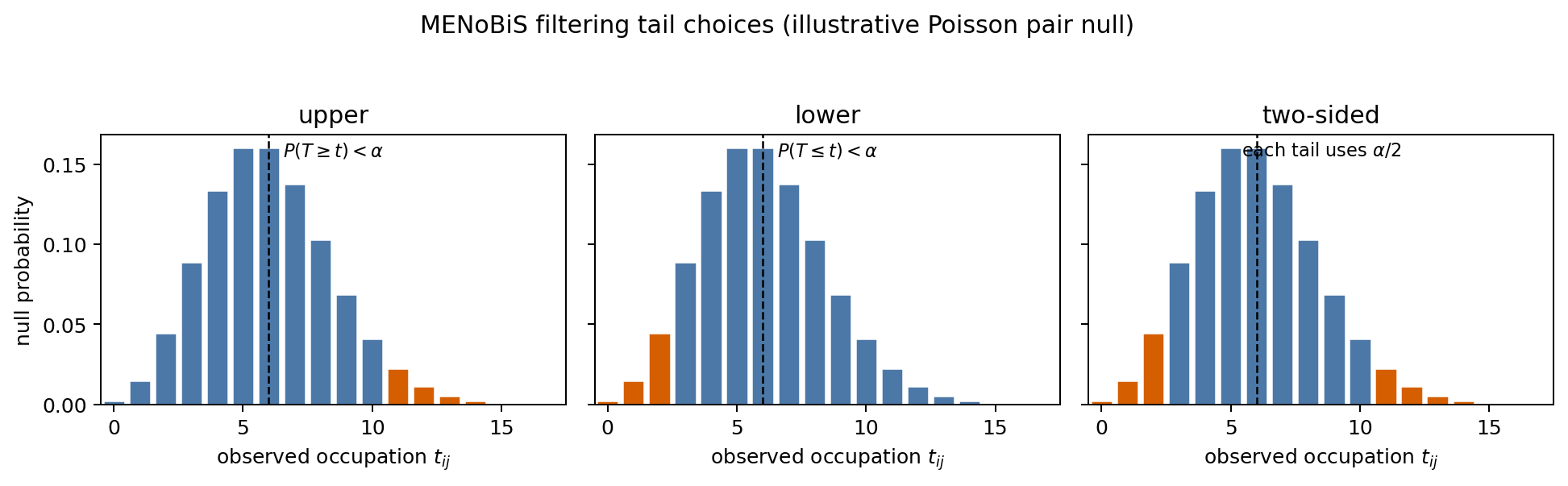
Tail choices
| Tail | Test |
|---|---|
upper |
observed occupation is larger than expected |
lower |
positive observed occupation is smaller than expected |
two-sided |
split alpha across upper and lower tests |
For observed positive pairs, MENoBiS uses conditional p-values under the positive support where appropriate. This avoids treating “pair exists” as random after selecting only existing observed pairs.
Two-sided tests
A two-sided filter with alpha=0.05 tests each tail at 0.025. Report the
tail and correction whenever you report filtered edges.
Multiple testing
| Correction | Meaning |
|---|---|
none |
compare each p-value directly with alpha |
bonferroni |
conservative family-wise correction |
fdr |
false-discovery-rate style threshold |
Start with none for exploration and report the correction used in scientific
work.
Absent edges
Absent-edge filtering is optional because it scans candidate pairs with observed occupation zero. Enable it when missing edges are scientifically meaningful:
result = filter_model(
    edges,
    family=ModelFamily.ME,
    constraint=Constraint.STRENGTH,
    fit=fit,
    detect_absent=True,
    min_occupation=0.5,
    max_absent=1000,
)
| Option | Meaning |
|---|---|
detect_absent |
scan zero-occupation candidate pairs |
min_occupation |
only report pairs likely to be occupied |
min_expected |
require a minimum expected occupation |
max_absent |
cap output size |
Interpretation
A significant pair is significant relative to the chosen null constraints. If a signal disappears after adding cost or degree constraints, it may be explained by those constraints rather than by higher-order structure.